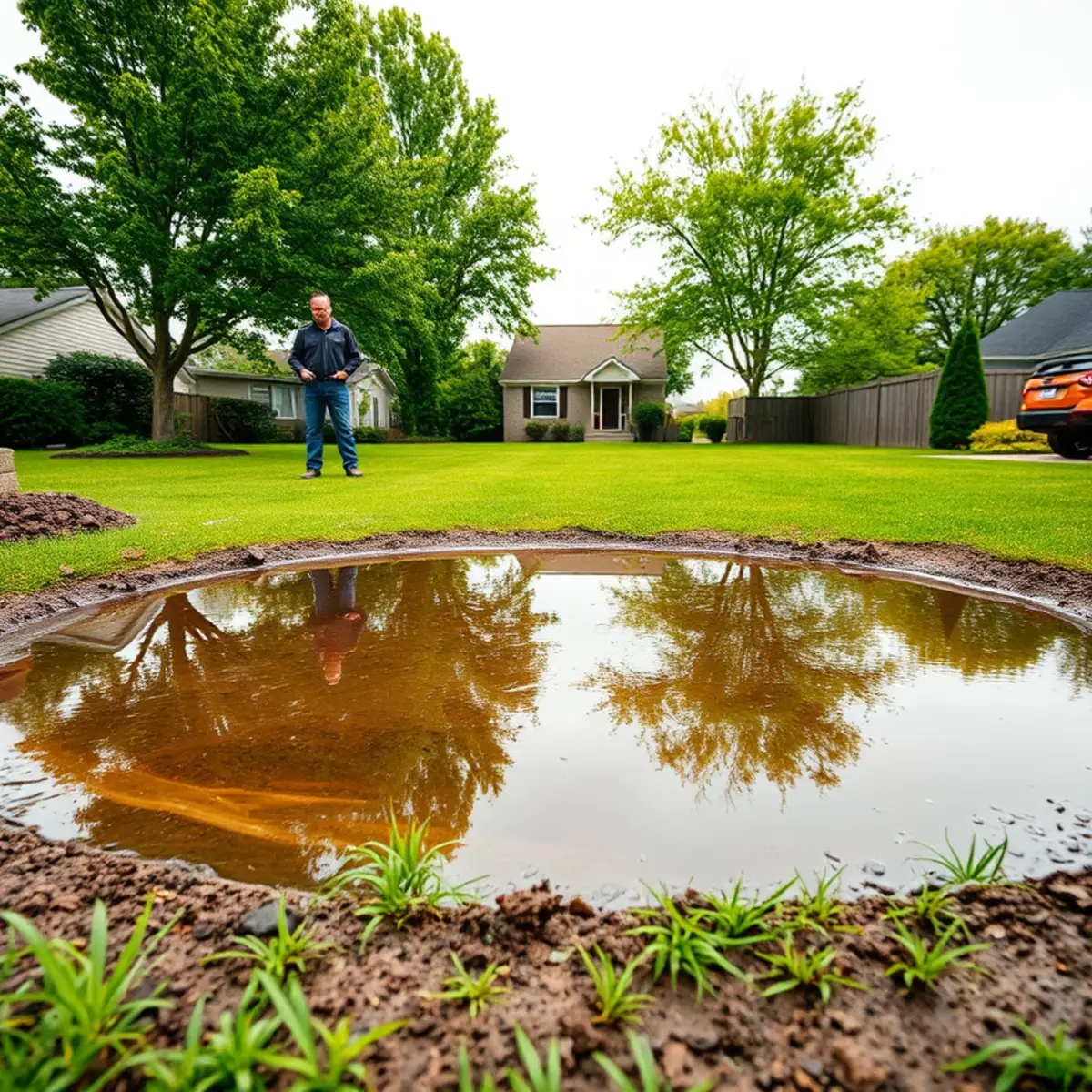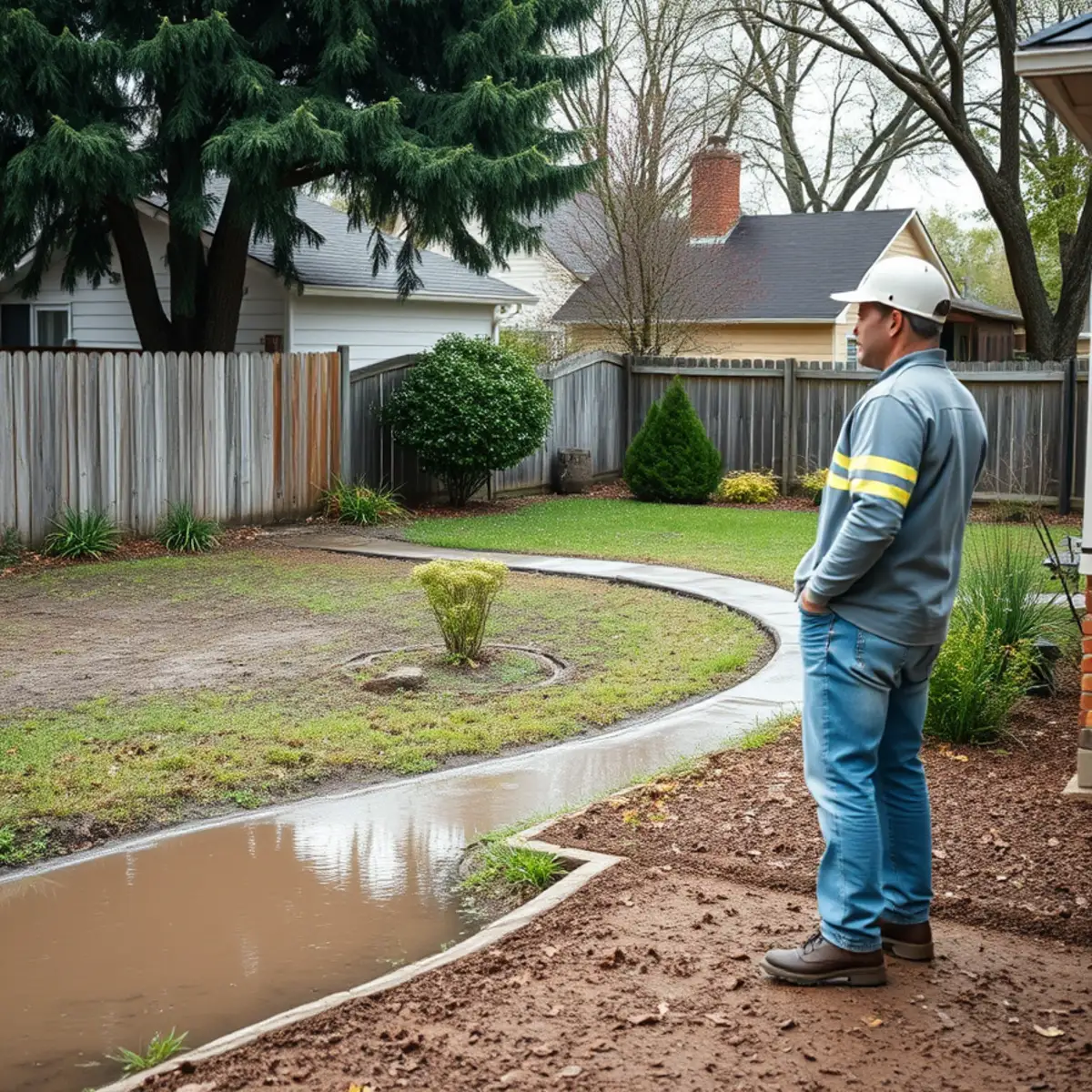
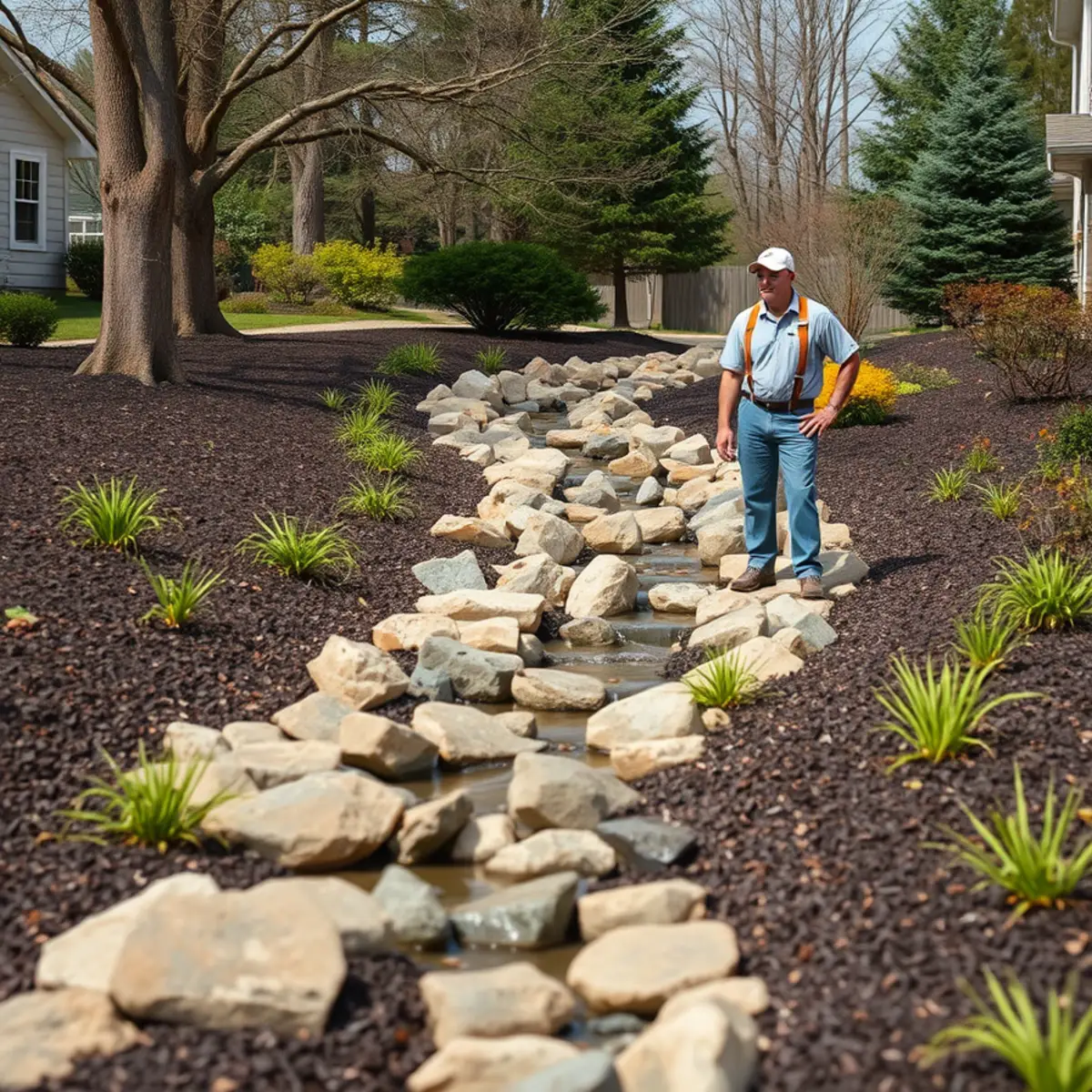
Choose a French drain when the problem is invisible — soggy, saturated ground that stays wet for days over our clay; it's a buried, gravel-packed pipe that collects subsurface water. Choose a dry creek bed when you can see water running across the surface; it's a stone-lined channel that carries that runoff away.
People ask us to "put in a French drain" all the time when what their yard actually needs is a dry creek bed — or the other way around. The two get lumped together because both move water, but they solve different problems, get built differently, and look nothing alike when they're done. Choose wrong and you either overspend or fail to fix the issue. Here's how to tell them apart and pick the right one for your lot.
The core difference in one line
A French drain is a hidden, underground system that collects water from below the surface. A dry creek bed is a visible, stone-lined channel that carries water across the surface. Underground versus on top — that's the heart of it, and it flows from what kind of water you're fighting.
When a French drain is the right call
Reach for a French drain when the problem is water you can't see: soggy ground that stays saturated for days, a spring-fed wet spot, water wicking toward a foundation, or a chronically mushy lawn over our slow-draining clay.
The French drain's job is to give subsurface water a path of least resistance. Buried in gravel, the perforated pipe sits lower than the wet soil around it, so groundwater seeps in and gets carried off to a safe outlet before it can pool at the surface. Because it's underground, it does its work invisibly — you get your lawn back with no feature interrupting it.
It shines in situations like:
- A backyard that squishes underfoot long after the rain stops
- Water collecting against a foundation or under a patio
- A flat, poorly draining lot where the whole surface stays wet
When a dry creek bed is the right call
Choose a dry creek bed when the problem is water you can see moving: storm runoff that sheets across the yard, water racing down a slope, or a downspout that carves a rut every time it rains. A dry creek bed gives that surface flow a defined, attractive channel to follow instead of eroding your lawn.
It's the better pick when:
- You've got visible runoff during storms, not just soggy ground
- There's a slope where water gains speed and cuts channels
- You want the fix to look like a design feature, not disappear
- Erosion is washing out mulch, soil, or a bed edge
Homeowners in Munster, where mature neighborhoods near the Monon and Erie Lackawanna trails have plenty of established landscaping to protect, often love that a dry creek bed handles runoff while adding a natural-looking stone element that fits right in.
How each one is built
The construction tells you why they cost and perform differently.
Building a French drain
- We trace the water source and plan a route to a real outlet — a French drain with nowhere to go is just a buried puddle.
- We dig a trench sloped consistently toward that outlet (slope is everything; too flat and it stalls).
- The trench gets lined with filter fabric to keep clay and silt from clogging the system.
- Perforated pipe is set in clean, washed gravel, wrapped, and backfilled.
- The surface is restored — usually reseeded so the lawn closes back over it and you'd never know it's there.
Building a dry creek bed
- We map the natural flow path and shape a shallow channel that follows where water already wants to go.
- We dig a gently curving, meandering bed — curves look natural and slow the water down.
- Landscape fabric goes down to block weeds.
- We set larger boulders along the banks and line the bottom with graded river rock, sizing the stone to the volume of water expected.
- We often plant the edges with tough natives so the whole thing reads as an intentional landscape feature.
Maintenance and looks, side by side
Maintenance. A French drain is low-effort but low-visibility — since you can't see it, the main risk is silt or roots clogging the pipe over years, which is why the filter fabric and a clean outlet matter so much. A dry creek bed is easy to maintain because it's right in front of you: pull the occasional weed, rake leaves out of the stone, and reset any rock that shifts after a big storm.
Looks. This is the clearest split. A French drain vanishes into the lawn — perfect when you want an unbroken yard. A dry creek bed is a design choice you see every day, adding texture and a natural, streambed character even when it's bone dry. Neither is better; it depends on whether you want the fix to hide or to show.
Why not both?
Plenty of Hobart yards use the two together, and that's often the smartest answer. A dry creek bed might carry surface runoff from a downspout across the yard, feeding into a French drain that handles the saturated low corner and pipes it to an outlet. Sorting out that combination — and getting the grading right underneath all of it — is the core of our drainage and grading solutions. On sloped lots, we sometimes pair drainage with a retaining wall that holds the grade and controls where water goes, then tie everything into a finished landscape design so the repair looks like it was always meant to be there.
Ready to solve your water problem for good?
The difference between a fix that lasts and money down the drain is diagnosing the water correctly first. Rome and the crew will read your lot right here in Hobart, figure out whether you need a French drain, a dry creek bed, or both, and build it to handle our clay and our storms. When you're ready to stop fighting the water, reach out through our contact page for a free on-site estimate.
Frequently asked questions
Which one is cheaper?
It depends on length, depth, and materials, not the type alone. A short dry creek bed can cost less than a long, deep French drain, or vice versa. The right question isn't which is cheaper — it's which actually solves your water problem, because the wrong cheap fix is the most expensive of all.
Will a dry creek bed have water in it all the time?
No. It's "dry" by design — it only carries water during and shortly after rain, then sits as an attractive stone feature the rest of the time. That's exactly what makes it work in a yard.
Can a French drain fail?
It can if it's built wrong — too little slope, no filter fabric, or no real outlet. Silt and roots are the usual long-term enemies. Built correctly with the right materials, a French drain quietly performs for many years.
How do I know which one my yard needs?
Watch a storm. If you see water running across the surface and cutting paths, lean dry creek bed. If the ground just stays wet and mushy long after with no visible flow, lean French drain. When it's both — which is common on our clay — we'll design the combination on-site.
Need help with drainage & grading?
The crew behind this guide handles drainage & grading solutions across Hobart and Northwest Indiana. Get a free, no-pressure on-site estimate.