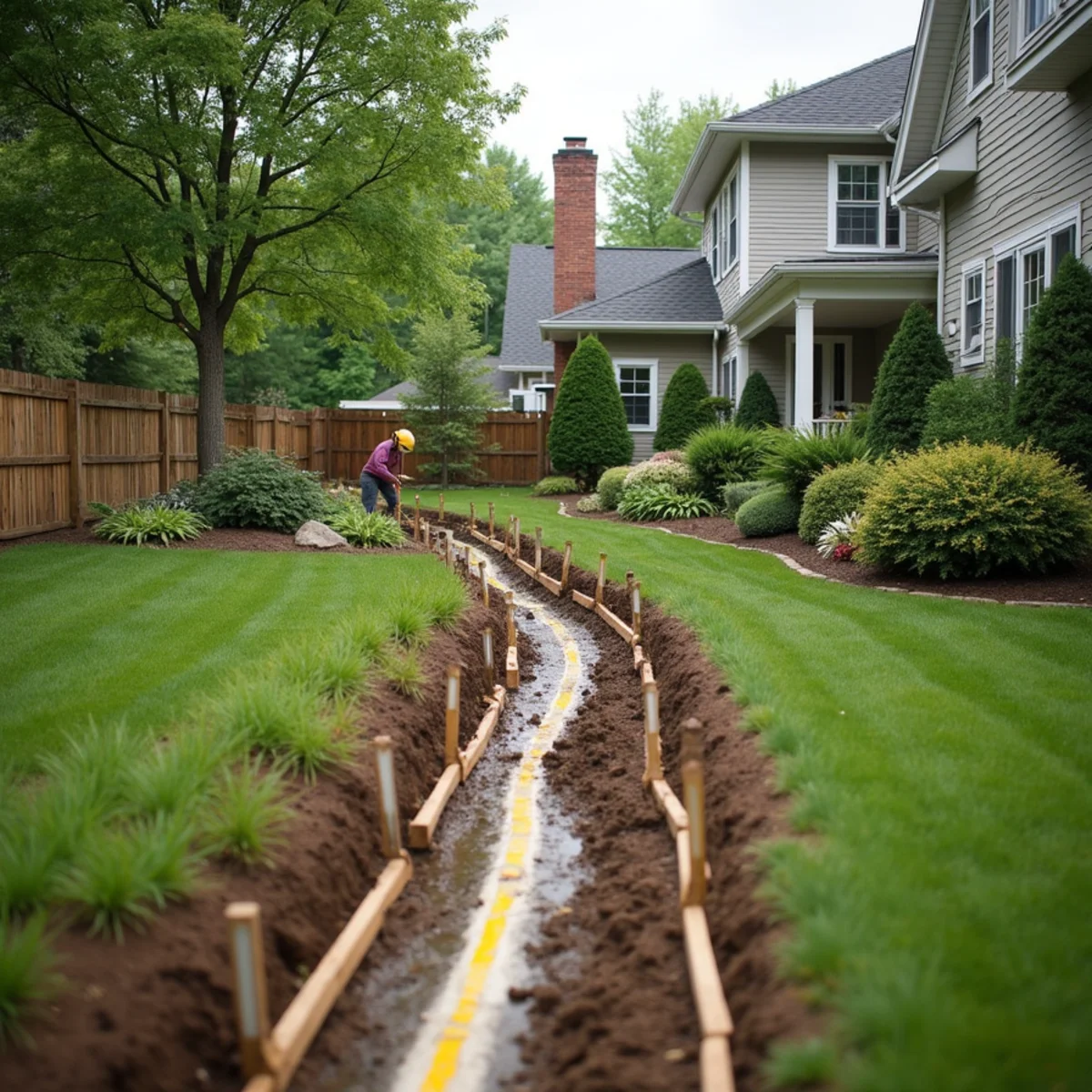
What drainage work costs in Northwest Indiana depends on what's actually wrong: a simple regrade is one level, a French drain or dry creek bed another, and a full system that moves water off a wet clay lot and away from the foundation is more involved. The size of the problem, the length of the run, and how far the water has to travel set the number — which is why a real estimate starts with seeing where the water goes.
Standing water, a soggy lawn, or a damp basement is more than an annoyance in The Region — on our clay it quietly damages lawns, patios, and foundations. The good news is that drainage is fixable; the question homeowners always ask first is what it costs. Here's an honest look at what drives the price, without pretending a yard can be quoted sight unseen.
What drives drainage cost
- The fix the problem needs. Regrading a low spot, installing a French drain, building a dry creek bed, extending downspouts, or adding a catch basin and dry well are different jobs at different price points. Many wet yards need a combination.
- Length and depth of the run. Water has to travel somewhere. A short run to daylight is simple; a long trench across the yard to a safe outlet means more digging, pipe, and gravel.
- How bad the grade is. Correcting a mild slope away from the house is lighter work than reshaping a yard that pitches toward the foundation.
- Clay and access. Our dense clay is slow, heavy digging, and a backyard reachable only through a narrow gate means more work by hand.
- The outlet. Where the water ends up — a lower corner, the street, a dry well — affects how much pipe and excavation the job takes.
Change any of those and the estimate changes, which is why walking the yard during or just after a rain tells us far more than any phone quote could.
Why clay makes drainage its own category here
In a lighter-soil region, water soaks in. In Northwest Indiana, our Lake County clay sheds it — rain sits on the surface, runs toward the lowest point (often the house), and freezes and heaves in winter. That means drainage solutions here have to actually move water to a planned outlet, not just hope it percolates. A fix that would work on sandy loam fails on our clay, which is why cut-rate "just add some gravel" jobs rarely hold. We design drainage and grading around what clay actually does.
Spending smart on drainage
- Fix the cause, not the symptom. Regrading so water never pools beats endlessly bailing out a low spot.
- Bundle with other digging. If you're already installing a patio or a retaining wall, handling drainage during the same excavation is far cheaper than opening the ground twice.
- Protect the foundation first. Water against the house is the most expensive problem to ignore — downspout extensions and grading there are high-value, lower-cost wins.
- Catch it early. A minor wet spot is cheaper to solve than the eroded beds, dead grass, or basement moisture it turns into. Our guide to the signs you need drainage help covers what to watch for.
Is it worth it?
Drainage rarely shows off the way a new patio does, but it protects everything else you spend money on — the lawn, the plantings, the hardscape, and the foundation. On a clay lot that pools water, it's often the first thing worth doing, because nothing else you plant or build survives sitting in water. If you've been fighting standing water season after season, the fix usually costs less than another year of damage.
Ready to solve a wet yard?
The real cost of drainage lives in your yard — how much water, where it's coming from, and where it can safely go. Rome and the crew will walk the property, ideally after a rain, anywhere from Hobart to Munster, and lay out the fix that actually solves it along with a clear estimate. Reach out through our contact page for a free on-site drainage estimate.
Frequently asked questions
Why can't you give a drainage price over the phone?
Because the cost depends entirely on where the water is coming from and where it can go — and that's only clear in person, ideally during or after a rain. A low spot that needs a short regrade and a yard that needs a full French-drain system to a distant outlet are very different jobs. We walk the property, find the actual water path, and give you a straight written quote.
What's the cheapest way to fix yard drainage?
When it works, regrading to move water away from the problem area is often the most cost-effective fix because it addresses the cause instead of managing the symptom. Downspout extensions are another low-cost, high-value start. Bigger problems need a French drain, dry creek bed, or catch basins — we'll recommend the least-invasive fix that actually solves it.
Does drainage work damage my lawn?
There's some disturbance where we trench, but we plan the route to minimize it and restore the surface when the work is done. The alternative — leaving water to pool — does more lasting damage to the lawn than a planned, restored trench.
Can drainage be done on a yard that's already landscaped?
Yes. We route runs to work around established beds, patios, and trees as much as possible, and restore what we disturb. It's more planning than a bare lot, but it's routine work — most of the yards we fix are already lived-in.
Need help with drainage & grading?
The crew behind this guide handles drainage & grading solutions across Hobart and Northwest Indiana. Get a free, no-pressure on-site estimate.